
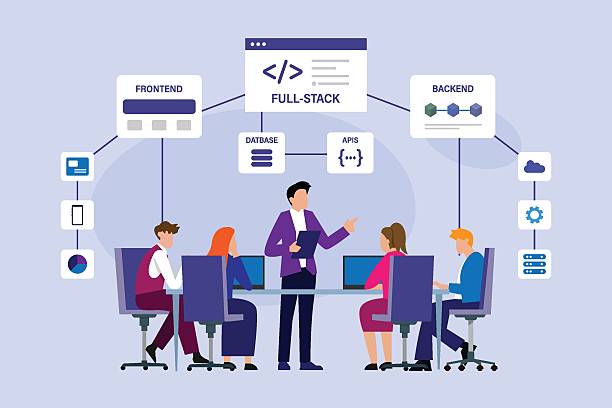

Technology trends come and go faster than most people can keep up with, but one skill has remained consistently valuable through all of it: being able to build a complete application from start to finish. That is essentially what full stack development means. Instead of only knowing how a website looks, or only knowing how the server handles data, a full stack developer understands both sides well enough to build something that actually works end to end. For students in Trichy weighing their options, this is one of the more durable paths available right now.
Breaking Down What Full Stack Actually Means
The word sounds intimidating, but the idea is simple. Every application has a front end, which is what the user sees and interacts with in the browser, and a back end, which handles data, logic, and storage behind the scenes. A full stack developer can work comfortably on both. That usually means knowing HTML, CSS, and JavaScript along with a front end framework like React, plus a back end language such as Node.js, Python, or Java, along with databases like MySQL or MongoDB. You do not need to be equally expert at everything, but you need enough working knowledge to connect the pieces together without depending entirely on someone else.
Why Companies Prefer Hiring Generalists Now
Smaller companies and startups, which make up a large share of the hiring market today, often cannot afford to have five specialists for five tiny parts of a project. They would rather hire two or three full stack developers who can handle most of the work between them. This preference has quietly reshaped hiring over the last several years. Even larger companies now often prefer developers who understand the full picture of how an application works, since it makes collaboration between teams smoother and reduces the back and forth that happens when specialists only understand their own narrow piece.
The Learning Curve Is Real, But Manageable
It is fair to say full stack development takes longer to learn properly than a single narrow skill, simply because there is more ground to cover. But the pieces build on each other logically. Learning HTML and CSS first gives you a visual result quickly, which keeps motivation high. JavaScript adds interactivity. A back end language and database then complete the picture of how data actually moves and gets stored. Students who try to learn all of this by jumping between random tutorials often end up with gaps, which is exactly the kind of thing a structured course is designed to prevent.
Building Projects That Actually Reflect Real Work
Reading about full stack development and building something with it are two very different experiences. A good course should have you build at least a couple of complete applications, such as an e-commerce style site with a working cart and checkout flow, or a booking system with a login and database behind it. These projects become the backbone of your portfolio and give you something concrete to walk an interviewer through, which matters far more than listing technologies on a resume without proof of having actually used them.
Studying Close to Home in Trichy
There is a common assumption that serious tech training only happens in Chennai, Bangalore, or Hyderabad. That has changed quite a bit. A properly designed Full Stack Development Course in Trichy now offers the same depth of curriculum locally, without the added cost and disruption of relocating. Trainers who understand both the technical material and the regional job market can also guide you toward companies and startups actually hiring in and around Trichy, which is something a generic online course simply cannot offer.
What to Check Before You Enroll
Ask what technologies the course actually covers on the back end, since some programs are front end heavy and call themselves full stack loosely. Ask how many complete projects you will build, not just individual exercises. A genuine Full Stack Development Course in Trichy should be able to show you sample projects from previous batches and explain clearly how the course prepares you for interviews, including common technical questions you are likely to face.
Common Mistakes Beginners Make While Learning
One of the most frequent mistakes is trying to learn every framework at once instead of getting genuinely comfortable with one front end and one back end technology first. Another common issue is copying code from tutorials without pausing to understand why each piece works, which leaves students unable to debug even small errors independently later on. Skipping database fundamentals is another trap, since many beginners focus heavily on making things look good visually while neglecting how data is actually structured and stored, which becomes a serious gap the moment a real project requires anything beyond static content. A structured course helps avoid these pitfalls simply by enforcing a sensible order to the material, but it still helps to know these traps exist in advance, so you can be deliberate about slowing down on fundamentals rather than rushing toward flashy features you are not yet ready to build reliably.
Conclusion
Full stack development is not the easiest path, but it tends to be one of the more secure ones, because it keeps you adaptable as specific frameworks and trends shift around underneath the industry. If you are willing to put in the time to learn both sides of how applications work, you end up with a skill set that stays relevant far longer than any single trendy tool. Choosing a course that emphasizes real projects over theory is the difference between a certificate on paper and a genuinely useful skill set.