
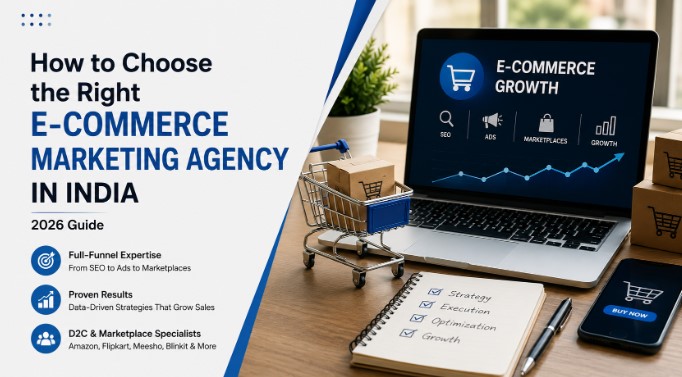

India’s online retail market has moved well past the early-adopter phase. Marketplaces, quick-commerce apps, and D2C storefronts now compete for the same customer inside the same 30-second attention span, which means the brands winning in 2026 are the ones with a proper e-commerce marketing partner behind them — not just a freelancer running the occasional ad.
The problem most founders run into isn’t a shortage of agencies. It’s the opposite: hundreds of vendors claim to be an “e-commerce marketing company” while actually offering only one piece of the puzzle — ads, or SEO, or catalog work, in isolation. This guide breaks down exactly what to evaluate before signing a retainer, so the agency you choose can actually move revenue, not just vanity metrics.
What Does an E-Commerce Marketing Company Actually Do?
A genuine e-commerce marketing agency operates across the entire customer journey — from the first search or scroll to the final checkout and repeat purchase. That typically spans marketplace account management, SEO for product and category pages, performance marketing (Meta and Google Ads), content and creative production, and increasingly, quick-commerce visibility on platforms like Blinkit, Zepto, and Instamart.
The distinction matters because a brand that hires five different specialists for these five functions usually ends up with disconnected strategies — the ad account optimises for clicks while the SEO team optimises for a completely different keyword set, and nobody owns the actual P&L outcome.
Why Indian D2C and Marketplace Brands Need Specialised E-Commerce Marketing Services
Selling online in India isn’t the same game as running a Shopify store in the US or Europe. Indian consumers split their buying across Amazon, Flipkart, Meesho, and D2C websites, often comparing prices across all four before purchasing. Add in the rapid rise of quick commerce, GST-linked seller compliance, and COD-heavy order patterns, and it becomes clear why a generic “digital marketing agency” often falls short.
Brands need a team that understands category-specific nuances — how a skincare brand’s Amazon A+ content differs from what converts on a D2C landing page, or why a solar equipment manufacturer’s B2B buyer behaves nothing like a fashion shopper on Meesho.
7 Things to Check Before Hiring an E-Commerce Marketing Agency in India
Use this checklist during discovery calls rather than relying on a polished pitch deck alone.
- Marketplace AND D2C experience — not just one. Ask for examples across Amazon/Flipkart account management and independent Shopify or WooCommerce growth.
- Full-funnel capability under one roof — SEO, performance ads, content, and catalog optimisation, so strategy isn’t fragmented across vendors.
- Transparent, weekly reporting with no long lock-in contracts. Agencies confident in their results rarely need annual handcuffs.
- Category-specific case studies. A pharma or FMCG brand should ask for results from similar categories, not just generic “200% ROAS” screenshots.
- Creative and performance working together — ad creatives that are built and iterated based on what’s actually converting, not designed in isolation.
- Realistic expectations on ROAS, CAC, and timelines. Be wary of anyone guaranteeing exact numbers before even auditing your account.
- Ability to scale across channels — Amazon, Flipkart, Meesho, JioMart, Blinkit, Zepto — as your business grows, without needing a new vendor for each platform.
Red Flags to Avoid
A few warning signs are worth flagging early. Agencies that promise guaranteed rankings or a fixed ROAS before doing any account audit are overselling. So are vendors who can’t explain how they’ll report performance beyond a monthly PDF with no raw data access.
Equally risky: agencies that outsource execution to freelancers without disclosing it, or that push for a 12-month contract before running even a trial sprint. A results-driven partner should be comfortable starting smaller and earning the larger mandate.
What Good Looks Like: A Quick Checklist
Before signing, the agency should be able to walk through a clear four-step process: a discovery and audit phase, a custom strategy document with defined KPIs, an execution plan with named owners, and a monthly optimisation cadence with transparent numbers.
Several full-service teams across India — including agencies like Brand Chanakya, which structures its engagements around exactly this discovery-strategy-execute-optimise framework for D2C and marketplace sellers — follow this model closely, and it’s a useful benchmark when comparing proposals from different vendors.
Conclusion
Choosing an e-commerce marketing company is less about the pitch and more about process discipline — can they show you exactly how discovery turns into strategy, and strategy turns into a reported, optimised outcome? Brands that ask these questions upfront save themselves months of wasted ad spend and mismatched expectations. Before signing a retainer, request a working audit of your current listings or ad account — a serious agency should offer this without hesitation. Agencies such as Brand Chanakya offer this kind of audit-first approach for brands evaluating their e-commerce growth partners.
About the Author
Brand Chanakya is an Udaipur-based digital growth and e-commerce marketing agency helping SMEs, manufacturers, startups, and D2C brands scale through SEO, marketplace management, performance marketing, and e-commerce solutions. With 10+ years of experience and 1,500+ businesses served, the agency focuses on practical, ROI-driven strategies that deliver sustainable business growth.