
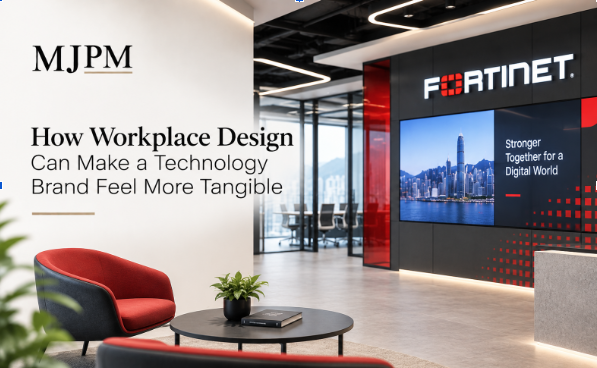

Technology companies are often defined by products people cannot physically hold: platforms, infrastructure, security systems and services delivered through a screen. Their office is one of the few places where a brand can be experienced in three dimensions. That makes workplace design more than an internal facilities decision. It becomes a way to translate an organisation’s character into an environment for employees, clients and visitors.
The translation should begin with the company’s real working culture, not a generic idea of what a technology office ought to look like. Some teams need a calm setting for specialist work and customer support. Others depend on rapid collaboration, product demonstrations or regular workshops. A workplace that simply adds bright colours, writable walls and a games area may look contemporary, but it will not necessarily support the habits that matter most.
For a cybersecurity or enterprise technology business, trust is often central to the brand. The physical environment can express that through precision, organisation and well-resolved details. A reception space may feel welcoming while still projecting assurance. Meeting rooms can incorporate technology discreetly, giving discussions a professional, uninterrupted flow. Work areas can feel open and connected without sacrificing the focus required by technical roles.
Brand elements work best when they are integrated, rather than applied as graphics at the end of a project. A colour from the visual identity might appear in a joinery detail or a carefully placed feature wall. A geometric motif might inform a screen or lighting composition. These touches become more convincing when they sit within a complete spatial story, supported by materials and proportions that feel appropriate to the organisation.
The employee experience matters just as much. Technology businesses compete for people who expect flexibility, useful amenities and a workplace that makes everyday tasks easier. This does not require an extravagant fit-out. It requires well-judged decisions: a variety of work settings, places for private calls, accessible collaboration areas, good ergonomic planning and meeting rooms that work when clients or remote colleagues join the conversation.
As businesses grow, the workplace can also become a useful anchor for culture. It gives new hires a sense of how the company works, creates regular points of connection between teams and makes a clear statement about the standard of care expected in day-to-day work. The strongest offices do not compete with the brand; they quietly reinforce it.
MJPM brings this thinking into office design and build projects across Hong Kong, combining visual identity with the operational requirements of a working environment. Learn more about its approach on the MJPM website. Its Fortinet Hong Kong headquarters project is also worth exploring as an example of a modern, efficient workplace that uses a clean and professional environment to support a global technology brand.