
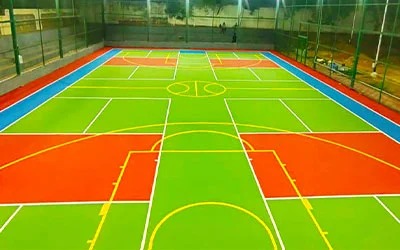

Sports facilities today need to accommodate multiple activities within limited space and budget constraints. This growing demand has made the multipurpose court one of the most popular solutions for schools, colleges, residential communities, sports clubs, and recreational centers.
A well-designed multipurpose court allows users to play basketball, tennis, badminton, volleyball, pickleball, futsal, and other recreational sports on a single surface. However, achieving long-term performance requires selecting the Best Multi Purpose Court Flooring, proper planning, and professional construction techniques.
This guide covers everything you need to know about multipurpose court design, flooring materials, construction processes, costs, and maintenance.
What Is a Multipurpose Court?
A multipurpose court is a sports facility designed to support multiple games and recreational activities on one playing surface. Instead of constructing separate courts for different sports, a multipurpose court combines various court markings and performance features into a single space.
These courts are commonly used in:
- Schools and universities
- Residential townships
- Sports academies
- Public parks
- Recreational centers
- Corporate campuses
- Community sports facilities
Multipurpose courts maximize space utilization while reducing overall construction costs.
Benefits of a Multipurpose Court
Efficient Use of Space
One court can accommodate multiple sports activities, making it ideal for locations with limited available land.
Cost Savings
Building a single court is significantly more economical than constructing multiple dedicated sports courts.
Increased Facility Usage
Different sports can be played throughout the day, increasing the utilization rate of the facility.
Easy Maintenance
Modern flooring systems require minimal maintenance and provide long-term durability.
Enhanced Community Engagement
A multipurpose sports facility encourages participation across various age groups and sporting interests.
Importance of Choosing the Best Multi Purpose Court Flooring
The flooring system plays a crucial role in player safety, comfort, performance, and durability.
The Best Multi Purpose Court Flooring should provide:
- Consistent ball bounce
- Excellent grip and traction
- Weather resistance
- UV protection
- Shock absorption
- Long-term durability
- Low maintenance requirements
A high-quality flooring system ensures optimal performance across multiple sports while reducing repair and maintenance costs.
Best Multi Purpose Court Material Options
Selecting the Best Multi Purpose Court Material depends on factors such as climate, budget, intended sports, and maintenance requirements.
1. Acrylic Sports Flooring
Acrylic flooring is considered one of the most widely used materials for outdoor multipurpose courts.
Advantages
- Durable surface
- UV-resistant coating
- Anti-slip texture
- Weather resistance
- Low maintenance
- Cost-effective installation
Acrylic flooring is suitable for:
- Basketball courts
- Tennis courts
- Volleyball courts
- Badminton courts
- Pickleball courts
2. Cushion Acrylic Flooring
Cushion acrylic systems incorporate resilient layers beneath the surface coating.
Benefits
- Improved shock absorption
- Reduced joint stress
- Enhanced player comfort
- Professional-level performance
These systems are preferred for high-usage sports facilities and training academies.
3. Polyurethane (PU) Flooring
PU flooring provides superior flexibility and player comfort.
Benefits
- Excellent durability
- High impact resistance
- Comfortable playing surface
- Seamless finish
PU flooring is commonly used in indoor multipurpose courts.
4. Modular Sports Tiles
Interlocking sports tiles are increasingly popular for recreational facilities.
Advantages
- Quick installation
- Easy maintenance
- Portable system
- Drainage-friendly design
These surfaces are ideal for schools, community centers, and temporary sports installations.
Key Factors When Designing a Multipurpose Court
Successful court design requires careful planning to accommodate multiple sports without compromising functionality.
Court Dimensions
The size of the court depends on the sports being played.
Common multipurpose court layouts include:
- Basketball and volleyball combination
- Tennis and pickleball combination
- Basketball, badminton, and volleyball combination
- Full recreational sports court
Professional sports flooring consultants can help optimize dimensions based on available space.
Surface Selection
The chosen flooring system must support all intended sports activities while maintaining player safety.
Drainage System
Outdoor courts require efficient drainage systems to prevent water accumulation and surface damage.
Lighting
Proper lighting ensures safe play during evening hours and improves overall user experience.
Fencing
Perimeter fencing helps protect the playing area and prevents balls from leaving the court.
Best Multi Purpose Court Construction Process
The quality of the foundation and installation directly affects the lifespan of the court. Following the Best Multi Purpose Court Construction process ensures long-term performance.
Step 1: Site Assessment
Construction begins with evaluating:
- Ground conditions
- Soil stability
- Water drainage
- Available space
Step 2: Excavation and Grading
The site is excavated and graded to achieve proper slope and drainage.
Step 3: Base Construction
The foundation is generally constructed using:
- Reinforced concrete
- Asphalt pavement
A strong base prevents cracks and surface deformation.
Step 4: Surface Preparation
The base is cleaned and leveled to create a smooth installation surface.
Step 5: Primer Application
A primer coat enhances adhesion between the base and flooring system.
Step 6: Resurfacer Layer Application
Resurfacer coats eliminate minor imperfections and create a uniform surface.
Step 7: Cushion Layer Installation
For cushion systems, multiple resilient layers are applied to improve player comfort.
Step 8: Color Coating
Specialized acrylic color coatings provide aesthetics, durability, and playing performance.
Step 9: Court Markings
Sports-specific line markings are applied according to official standards.
Step 10: Final Inspection
The completed court is inspected for:
- Surface consistency
- Line accuracy
- Drainage efficiency
- Overall finish quality
Why Acrylic Is the Best Multi Purpose Court Flooring
Among all available options, acrylic sports flooring remains the preferred choice for most outdoor multipurpose courts.
Superior Durability
Acrylic surfaces withstand heavy usage and varying weather conditions.
Weather Resistance
UV-resistant coatings protect against fading and surface deterioration.
Anti-Slip Safety
Textured finishes provide excellent traction during play.
Attractive Appearance
Acrylic systems are available in various colors and customized designs.
Low Maintenance
Routine cleaning and periodic inspections are typically sufficient to maintain performance.
Cost Factors for Multipurpose Court Construction
Several factors influence project costs.
Court Size
Larger courts require additional materials and labor.
Flooring System
Standard acrylic systems are generally more economical than cushion systems.
Base Construction
The condition of the existing ground significantly impacts construction expenses.
Accessories
Additional costs may include:
- Sports equipment
- Lighting poles
- Fencing
- Seating areas
- Drainage systems
A detailed site assessment helps determine accurate project costs.
Maintenance Tips for Multipurpose Courts
Proper maintenance extends court life and preserves performance.
Routine Cleaning
Remove dirt, leaves, and debris regularly.
Drainage Inspection
Ensure water drains properly after rainfall.
Surface Monitoring
Inspect for cracks, fading, or wear periodically.
Professional Resurfacing
Resurfacing every few years helps maintain appearance and playing characteristics.
Choosing the Right Multipurpose Court Contractor
Selecting an experienced contractor is critical for project success.
Look for a company that offers:
- Sports flooring expertise
- Quality-certified materials
- Professional installation
- Technical consultation
- Proven project portfolio
- Warranty support
A reliable contractor ensures the implementation of the Best Multi Purpose Court Construction practices and the use of the Best Multi Purpose Court Material for long-lasting performance.
Conclusion
A well-designed multipurpose court provides an efficient, cost-effective, and versatile solution for modern sports facilities. By selecting the Best Multi Purpose Court Flooring, using the Best Multi Purpose Court Material, and following professional Best Multi Purpose Court Construction methods, facility owners can create a durable and high-performance playing environment.
Whether for schools, sports academies, residential communities, or recreational centers, investing in quality multipurpose court flooring ensures safety, functionality, and long-term value for athletes and users alike.